
 2 days ago
1598
2 days ago
1598

Meta has completed an operational split from Manus, the agentic AI startup it bought for $2 billion barely six months ago.
The forced reversal of the deal was ordered by Chinese regulators in April, who claim that foreign investment and technology export rules were violated.
How did Beijing force a deal reversal between Meta and Manus?
Since early June, Meta has erected a data firewall between itself and Manus, the agentic AI startup it bought for $2 billion barely six months ago. Manus staff can no longer access Meta’s internal systems, and Meta employees cannot use Manus tools for internal projects.
An internal memo told staff to “sunset” Manus and move existing work onto Meta’s own platforms.
The forced separation comes after China’s top economic planner, the National Development and Reform Commission (NDRC), ordered the deal reversed in April 2026, claiming that foreign investment and technology export rules were violated. This is the first time Chinese authorities have successfully dismantled a completed cross-border AI acquisition.
China’s regulators argued that Manus was founded in China and its early research happened there. Its core team built the AI system using Chinese talent and data, so when Manus moved its headquarters and key staff to Singapore in 2025, Beijing saw this as an attempt to “cut ties” with China to avoid oversight.
The NDRC started an investigation in January 2026, just weeks after Meta closed the acquisition. By March, two of the company’s co-founders, Xiao Hong and Ji Yichao, were summoned to Beijing and barred from leaving the country. In April, the NDRC formally ordered the deal reversed.
Xiao Hong, Ji Yichao, and another co-founder, Zhang Tao, are now exploring whether they can raise roughly $1 billion from outside investors to fund a buyback that would match the $2 billion valuation Meta paid.
Investors who had already cashed out, including Tencent, ZhenFund, and HSG, complicate the financial mechanics of any reversal. Adding to that, staff have relocated into Meta’s Singapore offices, and Manus continues to ship product updates, including integrations with SimilarWeb and Shopify.
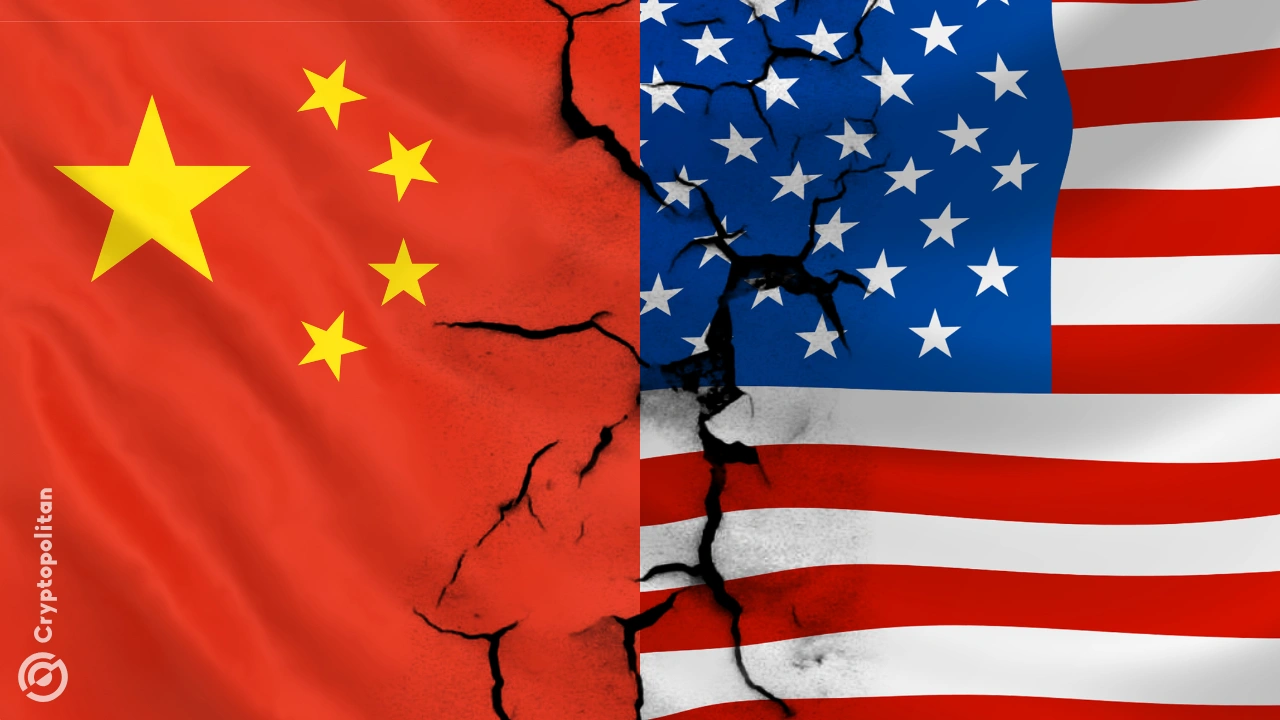
Escalating tit-for-tat between the U.S. and China
Cryptopolitan previously reported that regulators have instructed multiple private tech firms, including Moonshot AI, StepFun, and ByteDance, to reject American investment unless Beijing explicitly approves it.
The Trump administration has also limited American investment in certain Chinese AI, semiconductor, and quantum firms earlier this year, citing security concerns. U.S. officials accused Chinese labs of running large-scale campaigns to distill American AI models, a charge Beijing has rejected as “unjustified suppression.”
China has also tightened rare-earth licensing, banned foreign AI chips from state-funded data centers, and enacted regulations allowing authorities to seize assets of foreign entities that violate Chinese economic policies.
The U.S., meanwhile, has maintained export controls on advanced AI chips that constrain Chinese labs’ access to compute.
So far, American companies still lead on frontier model performance, according to Kyle Chan, a fellow at the Brookings Institution who testified before Congress in April that “China’s top AI models continue to lag behind American frontier models by several months or more.”
If you're reading this, you’re already ahead. Stay there with our newsletter.






![KOSPI Index Crash, South Korea Stock Market Bloodbath [LIVE] – 8th June](https://image.coinpedia.org/wp-content/uploads/2026/03/03183804/Korean-Stock-Market-Crash-KOSPI-Plunges-7-Amid-U.S.%E2%80%93Israel-Iran-War-1-1024x536.webp)


 English (US)