
 2 weeks ago
6166
2 weeks ago
6166

Jeff Park argued that crypto is entering a phase similar to Nvidia’s pre-mainstream AI era, when the technological shift was visible to early believers but not yet obvious to the broader market. In an X post defending crypto’s ideological roots on Sunday, Park framed today’s industry as being in a difficult “middle game” before onchain capital markets become self-evident infrastructure.
Park’s comparison centered on Nvidia CEO Jensen Huang and Elon Musk’s first public appearance together at GTC 2015, a moment he described as occurring inside a narrow window before AI had become a mainstream consumer or institutional priority. By then, Huang had spent decades backing parallel graphics processing and had supported CUDA since 2006, while Musk had already had what Park called his “Hassabis moment” in 2012. OpenAI, he noted, had not yet been founded.
“This is that narrow window where a revolution is visible to some but not others,” Park wrote, “in which both of these geniuses had early inklings of recognizing AI’s pervasive potential, but the broad public was not yet made aware. It would take another 10 years for it reach mainstream applications of course.”
Why Crypto Looks Like Nvidia
Park said he sees crypto in a similar position today. Before GPUs became central to the AI boom, the technology was sustained by gamers, hobbyists and researchers who pushed its capabilities without necessarily knowing they were helping subsidize a much larger computing transition. In his analogy, early DeFi played a comparable role for crypto by subsidizing the development path toward institutional tokenization.
“Gamers subsidized AI’s development, just like early DeFi subsidized the institutional tokenization development,” he wrote.
The core of Park’s argument is that crypto’s hardest phase is not the early ideological phase or the eventual mature phase. It is the transitional stage between them. He borrowed from Elon Musk’s remarks about autonomous driving at GTC 2015, where Musk said the simplest parts were very low-speed driving, where a vehicle can stop, and high-speed driving, where rules are more structured. The hardest part, in Park’s telling, is the 10-to-50 mph zone: urban environments with bikes, children, cones, manholes and edge cases requiring both precision and speed.
Park applied that framework to crypto infrastructure. The “0-10 mph” phase was permissionless money, a use case he said people could understand from a practical standpoint. The “50 mph+” phase, in his view, will be onchain capital markets becoming obvious because of self-custody, capital efficiency, money velocity and settlement optimization. The difficult part is what sits in between.
“But its the 10-50 thats hard, where money in a pre-internet financial infrastructure is hitting AML/KYC, offshore capital conduits, discretionary bank risk models, lagging reporting regimes create all kinds of need of need for precision and speed that institutional infrastructure today needs to develop further,” Park wrote. “Its fundamentally solvable, but this is the most challenging portion of fulfilling the dreams of onchain capital markets.”
Park also drew a distinction between Bitcoin and the wider crypto sector, while rejecting the idea that support for one must exclude the other. He said Bitcoin and crypto are not trying to solve identical problems, even if both originate from a similar ideological impulse around open access.
“I love bitcoin. But contrary to some opinion, I believe its possible to love crypto too, because bitcoin is a monetary experiment enabled by the evolution of technology, while most of crypto is the inverse: a technology experiment enabled by the evolution of money,” he wrote. “They are fundamentally solving different problems, though rooted in one ideal: to make its access as much of a public good as possible.”
Park’s broader thesis is that the ideology behind crypto is not fading but changing shape. He described the “winning ideology” as “technological financialization,” a form of hyperfinancialization with decentralizing elements that exports sovereign finance, agentic rails and self-determination as public goods.
That framing matters because much of the industry’s current debate is focused on whether crypto’s institutionalization weakens its original purpose. Park’s answer is that the ideological layer remains essential, but the practical expression of that ideology is now moving through financial infrastructure, tokenized markets and systems that need to interact with existing compliance and banking regimes.
“This ‘middle game’ period will be remembered as the most critical juncture for the industry,” Park wrote, adding that the future belongs to “those who recognized it was always ideological.”
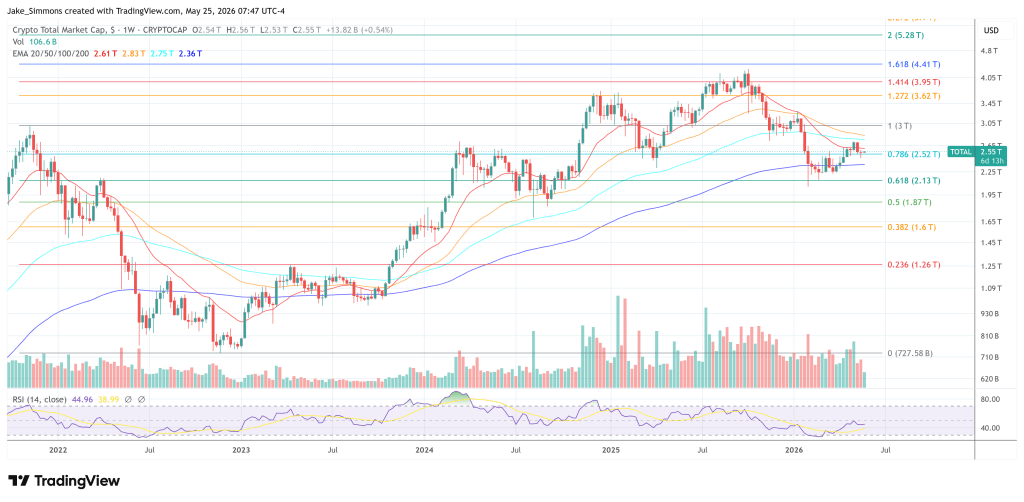
At press time, the total crypto market cap stood at $2.55 trillion.




![KOSPI Index Crash, South Korea Stock Market Bloodbath [LIVE] – 8th June](https://image.coinpedia.org/wp-content/uploads/2026/03/03183804/Korean-Stock-Market-Crash-KOSPI-Plunges-7-Amid-U.S.%E2%80%93Israel-Iran-War-1-1024x536.webp)








 English (US)