
 1 hour ago
74
1 hour ago
74

War is burning across the Middle East. Oil prices are climbing. Stock markets in Asia have taken a hit. And yet, Bitcoin is still standing above $66,000 — a fact that has caught the attention of analysts keeping a close eye on the market.
Calm Where There Should Be Panic
The group most closely watched during moments of market stress is what analysts call short-term holders — people who bought Bitcoin recently and are most likely to sell fast when things go wrong.
Based on reports from on-chain data platform CryptoQuant, that group has stayed unusually quiet. When Bitcoin slipped into the $63,000 to $64,000 range on Feb. 28, exchange inflows from recent buyers barely moved. No major wave of selling followed. No spike in coins being rushed to exchanges at a loss.
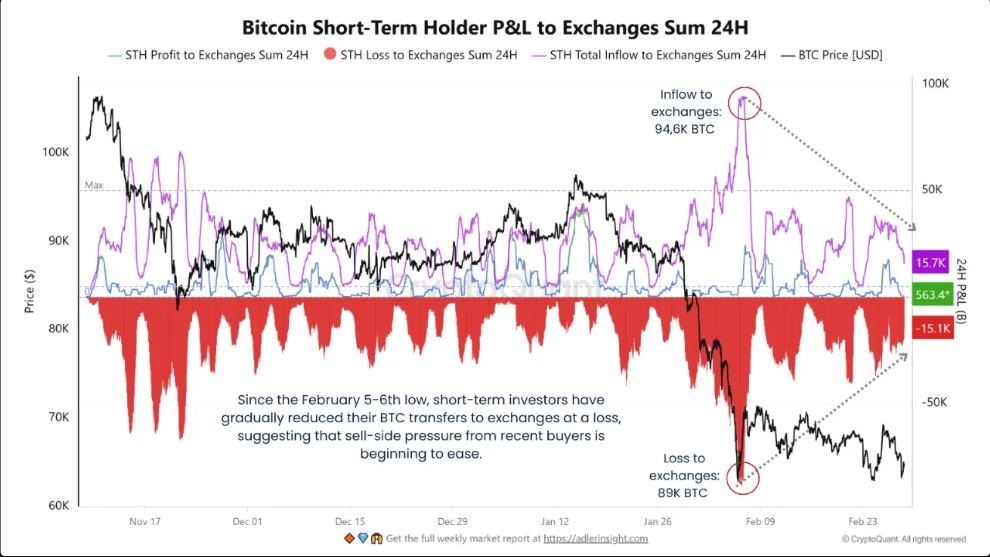
That was not the case earlier in February. Reports say that on Feb. 5-6, short-term holders sent 89,000 BTC to exchanges at a loss within a single 24-hour window. It was a clear panic event. Since then, those kinds of loss-driven transfers have been falling steadily — and the Iran escalation did not reverse that trend.
CryptoQuant analyst Moreno, who tracked the data, says this matters because markets tend to find their footing once the most nervous sellers have already exited.
If exchange inflows from short-term holders remain low, it could point to seller exhaustion and set the stage for a price recovery. A sudden jump in those inflows, however, would suggest the selling is not done.
What History Says About War And Bitcoin
This is not the first time Bitcoin has been tested by armed conflict. According to market analyst Ted Pillows, the pattern has played out twice before.
When Russia launched its invasion of Ukraine in February 2022, Bitcoin dropped — then surged 40%. When Israel struck Iran in June 2025, Bitcoin dipped again before gaining 25%.
Feb 2022: Russia attacked Ukraine.
 $BTC dumped first and then rallied 40%.
June 2025: Israel attacked Iran.
Bitcoin dumped first and then rallied 25%.
Feb 2026: US attacked Iran.
Will a similar pattern follow again? pic.twitter.com/b8FLF4aR9p
— Ted (@TedPillows) February 28, 2026
Now, following joint US-Israeli strikes on Iran in February 2026, Bitcoin has once again pulled back. Pillows is now asking whether that same rebound pattern could follow a third time.
The current conflict is far larger than those earlier flashpoints. Reports say US-Israeli forces struck more than 2,000 targets across 131 Iranian cities and provinces, hitting nuclear sites, missile systems, and senior military figures, including Iran’s Supreme Leader.
Bitcoin Price ActionIran fired back with missiles and drones aimed at Israel, US bases, and multiple Gulf states. The war has dragged in Lebanon, Bahrain, Saudi Arabia, Qatar, the UAE, Cyprus, and a UK military base.
Bitcoin has dropped 3.5% since Feb. 26, bringing its price to $65,540. It briefly touched $63,030 on Feb. 28 before climbing back above $65,000.
Given the scale of what is happening on the ground, that kind of price movement is relatively contained.
Featured image from Pexels, chart from TradingView













 English (US)