
 12 hours ago
1127
12 hours ago
1127

The crypto perpetual swaps market faced its most significant stress test to date in 2025, according to BitMEX’s State of Crypto Perpetual Swaps 2025 report. Long viewed as a core source of liquidity and yield, perpetual futures instead became a focal point for systemic failures, collapsing funding rates, and renewed questions around exchange practices.
The report examines how a year marked by liquidation cascades, exchange disruptions, and structural changes reshaped derivative trading across both centralized and decentralized platforms.
October ADL crisis exposes market structure weaknesses
According to the report, the defining event of 2025 occurred during the October 10–11 market crash, which triggered an estimated $20 billion liquidation cascade, the largest in crypto history. Unlike previous downturns, which largely affected retail traders, this episode primarily affected professional market makers.
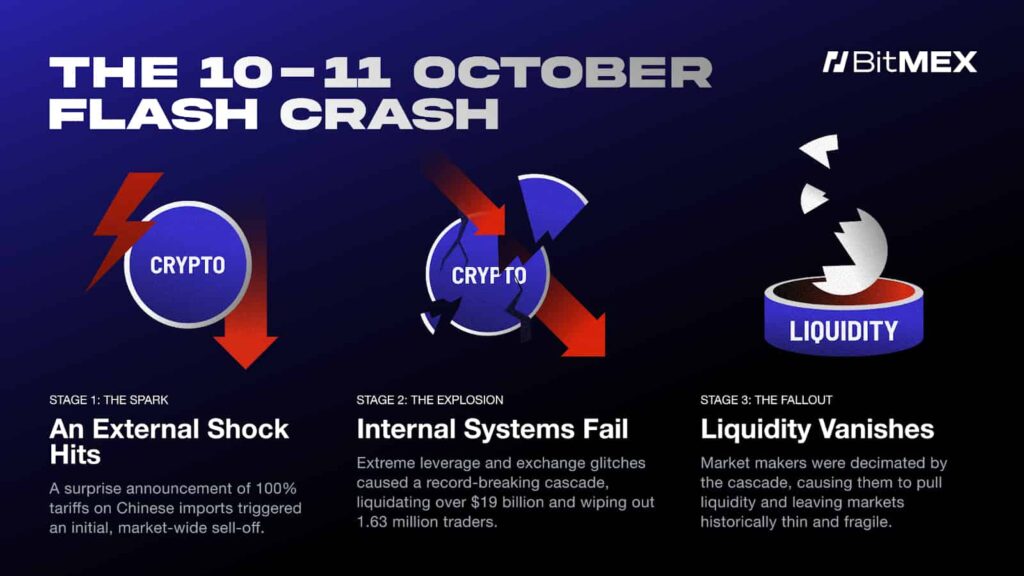 The October ADL Crisis. Source: BitMEX
BitMEX said auto-deleveraging (ADL) mechanisms broke delta-neutral strategies by forcibly closing short hedges, leaving firms exposed to falling spot prices. The resulting liquidity pullback led to the thinnest order books since 2022, raising concerns about the reliability of exchange risk engines during periods of stress.
Funding rate arbitrage compresses under heavy participation
The report also points to a sharp shift in funding rate dynamics during 2025. What had previously delivered double-digit yields became increasingly crowded as institutional participation and exchange-native products expanded.
According to BitMEX, automated short positioning compressed funding rates below historical norms. By mid-2025, yields had fallen to around 4%, often underperforming US Treasury bills. The findings suggest that funding rate arbitrage transitioned from a high-yield strategy to a more competitive and efficient trade.
Trust concerns emerge around exchange practices
BitMEX’s analysis highlights a widening gap between exchanges operating fair matching engines and those using so-called B-Book models. The report notes several instances where platforms invoked “abnormal trading” clauses to void profitable trades, effectively confiscating user gains.
High-profile low-float perpetual squeezes during the year further underscored how some venues directly benefited from user losses, contributing to a broader trust issue across the derivatives market.
Growth of perp DEXs introduces new risks
Decentralized perpetual exchanges gained traction in 2025, but the report warns that transparency introduced new attack vectors. Publicly visible liquidation levels enabled targeted strategies, particularly involving illiquid pre-token generation event (pre-TGE) assets with weak oracle design.
BitMEX said several incidents demonstrated that decentralization alone does not eliminate platform risk and that risk controls and accountability remain important considerations.
New derivatives products gain traction
As traditional strategies weakened, the report notes growing interest in new derivative products. Equity perpetuals enabled continuous trading of US stocks such as Nvidia (NASDAQ: NVDA) and Tesla (NASDAQ: TSLA), while funding rates themselves began trading as standalone instruments.
According to BitMEX, these developments point to a broader convergence between crypto and traditional markets, with derivatives infrastructure increasingly serving both asset classes.
Featured image via Shutterstock.
The post BitMEX report highlights structural shifts in crypto perpetual swaps market in 2025 appeared first on Finbold.











 English (US)