
 2 hours ago
252
2 hours ago
252

Ethereum continues to struggle under persistent selling pressure, with price action reflecting a fragile market environment and cautious investor sentiment. Since peaking in October, Ethereum has lost more than 60% of its value, marking one of the sharpest corrective phases of the current cycle. Analysts increasingly warn that downside risks remain elevated, particularly if broader crypto liquidity conditions fail to stabilize in the near term.
Despite the negative price performance, on-chain data suggests a more nuanced underlying dynamic. A recent CryptoQuant report indicates that Ethereum whales are currently holding positions at a loss, with the magnitude of those unrealized losses comparable to levels historically seen near previous market bottoms. This pattern often emerges late in corrective cycles, when large holders continue accumulating rather than distributing.
Notably, the report highlights that many of these large investors have not had meaningful opportunities to realize profits during this cycle, as they maintained accumulation strategies even through volatility. Such behavior can signal long-term conviction, although it does not guarantee an imminent reversal.
Whale Positioning Signals Potential Bottom Formation
The report argues that current on-chain positioning among large Ethereum holders may indicate that the market is approaching a cyclical bottom. According to the analysis, whales are currently sitting on losses comparable to those observed near previous market lows, a condition that historically coincided with late-stage corrective phases rather than early declines. This positioning suggests that the present price range could represent a structural floor, although confirmation typically requires stabilization in both price and liquidity conditions.

One notable aspect is that these large holders now control some of the largest aggregate ETH balances on record. Despite this accumulation, they have not had significant opportunities to realize profits during the current cycle, largely because prices reversed before extended distribution phases could occur. This absence of profit-taking contrasts with prior bull cycles, where whales gradually reduced exposure near peaks.
The report interprets continued accumulation under these conditions as preparation for a potential future rally rather than defensive repositioning. Large holders appear to be building exposure with a longer investment horizon, anticipating improved macro liquidity and renewed market momentum.
However, while such behavior can precede recoveries, it does not eliminate downside risk. Confirmation typically requires stronger demand, improved sentiment, and sustained price stability.
Ethereum Tests Critical Long-Term Support Zone
Ethereum’s weekly chart shows sustained downside pressure following the sharp rejection from the late-2025 highs near the $4,800 region. Price has now retraced toward the $2,000 psychological level, an area that historically acted as both resistance and support across multiple cycles. The recent breakdown below shorter-term moving averages confirms a loss of bullish momentum and suggests that sellers remain in control in the medium term.
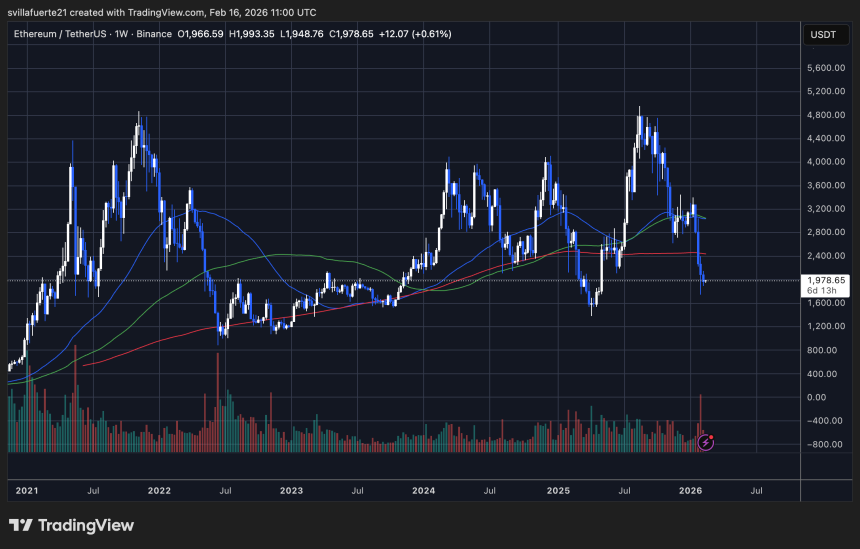
The clustering of major moving averages above the current price reinforces this bearish structure. The faster trend averages have rolled over decisively, while the longer-term baseline continues to flatten, indicating weakening trend strength rather than outright capitulation. This configuration typically reflects late corrective phases, where volatility rises but directional conviction remains fragile.
Volume dynamics add nuance. Elevated selling volume during the latest decline signals active distribution rather than passive drift. However, the absence of extreme capitulation spikes suggests that a full market flush may not yet have occurred.
From a structural perspective, holding above the $1,800–$2,000 corridor would help stabilize sentiment and potentially form a consolidation base. A sustained breakdown below this region could expose deeper historical support zones closer to prior cycle accumulation ranges. Conversely, reclaiming the key moving averages would be required before any credible trend reversal narrative emerges.
Featured image from ChatGPT, chart from TradingView.com










 English (US)