
 1 hour ago
1195
1 hour ago
1195
.png)
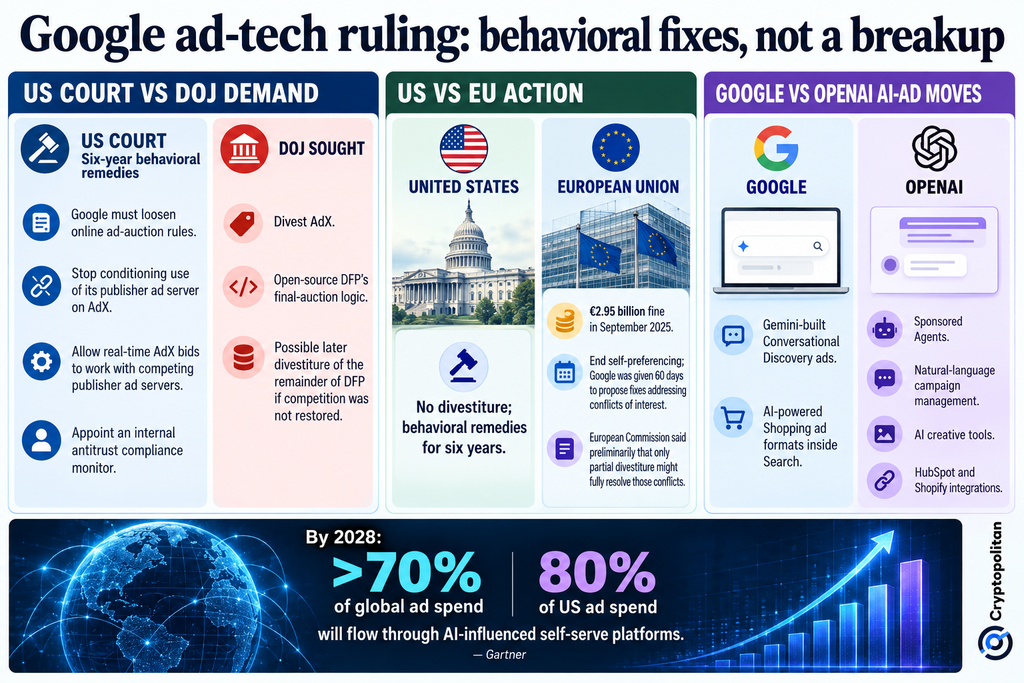
A federal court has ordered Google to adjust its online ad auction regulations, reduce practices that prevent publishers from utilizing alternative platforms, and appoint an internal antitrust compliance monitor. However, the court has refrained from specifying a breakup of the company that was requested by the US government.
U.S. District Judge Leonie Brinkema stated the measures to be implemented in a ruling made public on September 16. The measures are to be in effect for six years, as per the report by Reuters.
The timing is crucial. Publishers and competitors alike are already adapting to the market environment increasingly defined by AI-powered search and dialogue advertising. OpenAI’s rollout of new ChatGPT advertising features on September 16 shows how quickly that shift is taking shape.
What the court ordered Google to change
In her judgment in April 2025, Brinkema determined that Google had unlawfully attained a monopoly in parts of the publisher ad-server and ad-exchange markets. Instead of breaking the company apart, she opted for behavioral remedies to improve interoperability and reduce the connections between its various products.
Brinkema stated, as reported by Reuters:
will be sufficient to effectively pry open to competition the ad tech markets that were injured by Google’s unlawful conduct.
The remedies require Google to stop conditioning use of its publisher ad server on AdX and allow real-time AdX bids to work with competing publisher ad servers. The company must also appoint an antitrust compliance monitor.
The breakup the DOJ wanted, and didn’t get
The Justice Department sought something much larger than that. They have proposed a remedy resolution to demand that Google divest AdX and make disclosures about all the source code in relation to its auction technology. It also called for divestiture of more products in case the previously mentioned methods fail to restore competition.
Brinkema turned down those structural remedies.
In an interview with the New York Times, Lee-Anne Mulholland, Google Vice President of Regulatory Affairs, said:
We’re very pleased the Court rejected the D.O.J.’s proposal to break apart tools that help small businesses reach new customers and grow.
However, Google is planning to appeal the findings concerning liability connected to its publishing tools.
Why publishers and rivals are watching
Now the main question is whether increased interoperability actually influences advertising budgets.
Publishers might be able to be more flexible in deciding which advertising server to use and not be tied solely to Google’s own solutions. However, whether this is going to lead to significant development in the market share is hard to say.
The business in question is not that big within Alphabet’s company portfolio. According to the Times, Google’s ad-tech unit generated around $30 billion last year, representing around 8% of Alphabet’s revenue. As a previous report by Cryptopolitan pointed out, Google’s networking division accounted for approximately 12% of Alphabet’s revenue when the lawsuit was launched.
Advertising by all means is crucial for Alphabet. The company posted more than $96 billion in advertising revenue in Q2 2026.
The real contest is shifting to AI
OpenAI is testing Sponsored Agents that let users enter labeled conversations with business-backed agents after clicking ads. It has also introduced natural-language campaign tools, AI creative capabilities and integrations with HubSpot and Shopify.
Google is pushing in the same direction. Its advertising roadmap includes Gemini-built Conversational Discovery ads and AI-powered Shopping formats designed for more conversational search behavior.
Gartner expects more than 70% of global ad spending, and 80% in the U.S., to flow through AI-influenced self-serve platforms by 2028.
If legacy lock-in weakens as those platforms grow, competitors may find more room to win advertisers and publisher relationships. Whether the court’s remedies are enough to produce that outcome is still an open question.
Europe is pressing harder
The U.S. approach contrasts with Europe. In September 2025, the European Commission fined Google €2.95 billion for favoring its own ad-tech services, ordered it to end self-preferencing and gave the company 60 days to propose measures addressing conflicts of interest.
The Commission said preliminarily that only a partial divestiture might fully resolve those conflicts.
Together, the U.S. and European actions show regulators challenging Google’s ad-tech structure just as AI begins changing how digital advertising is bought, placed and delivered.
 Google Ad-Tech Ruling: US Remedies vs DOJ Breakup, EU Action and AI Ads
The smartest crypto minds already read our newsletter. Want in? Join them.













 English (US)