
 3 hours ago
467
3 hours ago
467

What to Know:
- Phantom’s in-app Chats expand social attack surface; scammers exploit hype and speed to route users into phishing links and fake prompts.
- Bitcoin and Ethereum remain choppy, with mixed spot ETF flow signals, conditions that tend to increase user error and rushed approvals.
- Strong wallet hygiene still matters most: never share seed phrases, avoid chat links, and isolate funds using separate accounts or hardware wallets.
- BMIC leans into a post-quantum + AI security narrative, aiming to reduce key-exposure risk as social-engineering attacks evolve.
Crypto’s biggest losses rarely start with a ‘hack.’ They start with a message.
Phantom’s in-app Chats, designed to let traders talk directly from token, perps, and prediction market pages, have expanded the wallet’s social surface area at exactly the moment phishing crews are getting more clinical. Phantom itself warns that Chats are not a support channel and users should be cautious with links, scams, and ‘financial advice from strangers.’
That caution is well-placed: social engineering thrives wherever speed, hype, and clickable URLs overlap. And yes, attackers read the same docs users do, then exploit the gray areas.
Recent scam reporting around the Phantom ecosystem has highlighted how lookalike popups and phishing pages attempt to trick users into entering seed phrases, sometimes by closely copying Phantom’s interface. Even without a single wallet exploit, an in-chat link can move a user from ‘conversation’ to ‘compromise’ in seconds. That’s fast.
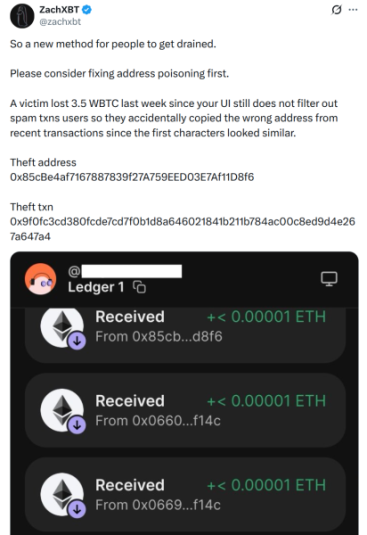
What most coverage misses is why chat-based delivery converts: it adds social proof. A link posted in a fast-moving token chat can feel like part of the product experience (almost like a built-in feature), lowering the friction that normally protects users from random DMs. Familiarity lowers guardrails.
Volatile price action, crowded trade chats, and familiarity create perfect phishing conditions. The second-order effect is ugly, once a seed phrase is exposed or a malicious transaction is signed, losses settle faster than any customer support ticket. No pause button.
This is where security narratives start to outperform meme narratives. And it’s also the bridge into BMIC ($BMIC): a presale-stage project pitching an AI-assisted, post-quantum security stack for wallets, staking, and payments, built for the uncomfortable reality that today’s attacks are human-first, and tomorrow’s risks may be cryptographic.
BMIC Pitches Post-Quantum Wallet Security with AI Threat Detection
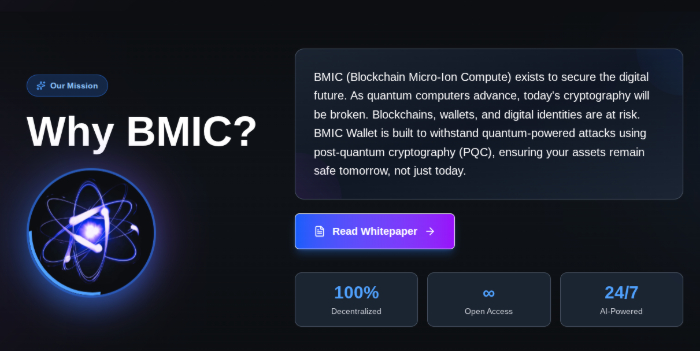
BMIC (ERC-20 on Ethereum) is positioning itself as a ‘Quantum-Secure Wallet’ project with a full-stack approach: wallet + staking + payments, protected by post-quantum cryptography and paired with AI-enhanced threat detection.
The narrative target is specific and timely: ‘harvest now, decrypt later.’ That’s the idea that adversaries can capture encrypted data today and crack it later when cryptographic capabilities improve. BMIC also claims Zero Public-Key Exposure and a ‘Quantum Meta-Cloud,’ while leaning on ERC-4337 smart accounts, an architectural choice that can support more programmable security policies than legacy EOAs.
Ambitious? Yes. Reckless? Not if executed with audits and clear threat models.
Why does this matter in the context of Phantom-style phishing? Because phishing scales on two levers:
1) Getting users to reveal secrets 2) Getting users to sign the wrong thing
BMIC’s pitch is that modern wallet security has to assume both levers are being pulled constantly, and respond with layered defenses, cryptographic hardening, plus automated threat detection that can flag abnormal behavior patterns.
CHECK OUT THE BMIC SECURITY STACK
BMIC Presale Raising for Future Security
$BMIC has raised over $445K, and tokens are currently priced at $0.049474. That’s a low entry price for something aimed at securing the future. It’s clear investors are looking for a high return by getting in early.
The $BMIC token acts as the primary utility currency for the BMIC ecosystem, used to pay for quantum-resistant security services and access decentralized computing power through a ‘Burn-to-Compute’ mechanism. It further incentivizes the network by allowing holders to stake tokens for rewards while participating in governance decisions regarding the protocol’s development.
The risk, of course, is execution. Post-quantum cryptography and AI security are powerful words, but buyers should watch for tangible deliverables: audited components, real user-facing threat telemetry, and clear explanations of how ‘zero public-key exposure’ is implemented in practice. Can it actually deliver?
Still, the setup is intuitive: as wallets add social surfaces like chat, attackers get more entry points. Projects built around reducing key exposure and automating threat detection have a clean reason to exist.
buy your $BMIC on the official presale page This article is not financial advice; crypto is volatile, presales are high-risk, and security claims should be independently verified.







 English (US)