 50 minutes ago
733
50 minutes ago
733
.png)
According to reports from Reuters, Factory, which is a startup located in San Francisco that builds AI agents for enterprise engineering teams, has raised $200 million, ushering its valuation to $5 billion, which is 3 times the initial valuation of $1.5 billion in April this year.
Such a leap—of about 3.3 times in basically five months—demonstrates how fast investors’ attention travels beyond copilot technologies. Money is now more actively flowing to those platforms which promise to automate a lot of software development processes, such as bug triaging and testing or even deployment and monitoring. The key question still is whether those platforms would become resources for enterprises without facing limitations regarding autonomy, expenses, and governance.
Who wrote the checks, and how it stacks up against Cognition
According to Reuters, the round was supported by Blackstone, Khosla Ventures, Sequoia Capital, Insight Partners, Evantic Capital, and Sound Ventures. Founded in 2023 by Matan Grinberg and Eno Reyes, Factory allows enterprises to use AI agents to design, test, and support software, positioning them as direct competitors to Cognition and Cursor.
The raise comes just one week after Cognition disclosed its Series E funding of over $2 billion at a $48 billion valuation, which was spearheaded by Andreessen Horowitz and Accel. According to information by Cryptopolitan, having close to doubled the company’s valuation from $26 billion in May, Cognition is now estimated at approximately 53 times the company’s run-rate revenues.
A Cryptopolitan analysis of the two companies’ disclosed funding data shows how sharply both have been repriced. Factory’s valuation rose about 233% from April to September, while Cognition’s increased about 85% from May to September. Factory has not disclosed comparable run-rate revenue in the supplied sources, so a like-for-like revenue multiple cannot be calculated.
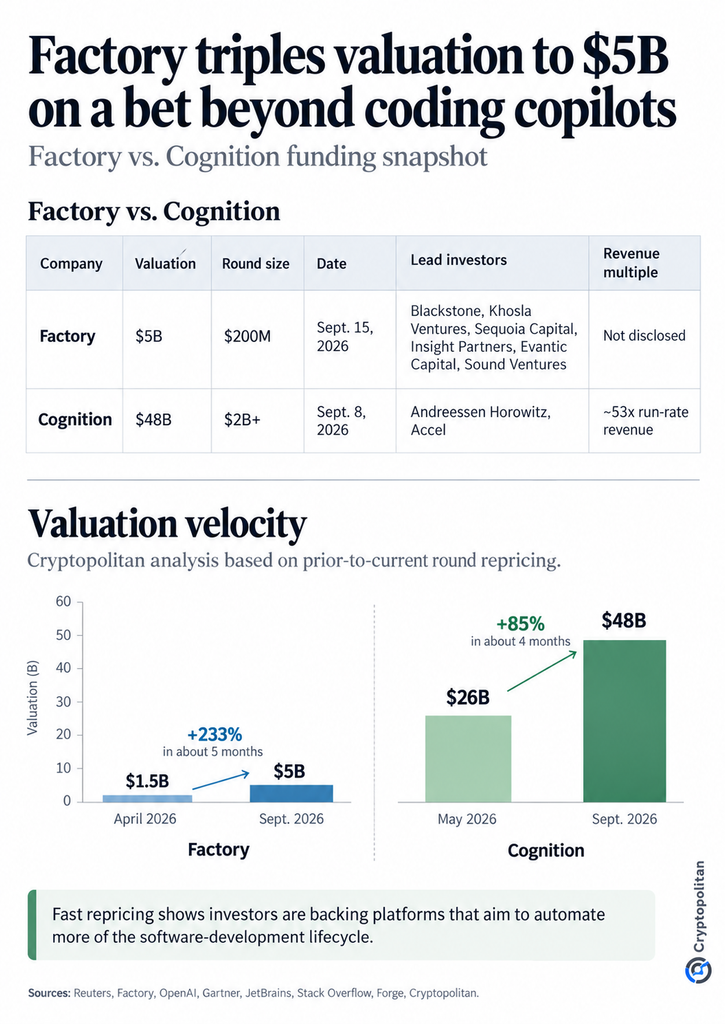 Factory vs. Cognition AI Valuation Growth and Funding Comparison 2026
From individual agents to “software factories”
This year, Factory is establishing itself as a firm that is not just a coding tool. Factory has defined a “software factory” in its June release as one that is a continuous system that starts with various signals, such as bug reports, internal communications, and customer feedback, and goes through stages of development, review, deployment, and monitoring. Factory claims various companies—including NVIDIA, EY, Adobe, Palo Alto Networks, Adyen, Blackstone, and Wipro—are using software factories in their operations.
Grinberg tied the most recent funding round to this statement, saying that huge corporations are starting to shift away “from individual coding agents to software factories” that can serve as the foundation for software operations.
That direction is also consistent with what Gartner believes. According to Gartner, enterprise AI coding agents are rapidly spreading throughout the software development lifecycle and expect that by 2027, over 65% of engineering teams that use agent-based coding will regard the integrated development environments (IDEs) as a non-essential tool.
Adoption is running ahead of trust
Demand is already quite high. JetBrains found that 90% of respondents in its Developer Ecosystem Survey of more than 15,000 professionals had used AI coding agents once a week or more during the period of May through July 2026, while 68% reported using them daily. Worldwide, Claude Code boasted of being the leader in adoption with 39% of adoption, while in America the number was 47%.
Trust still presents a challenge. A Stack Overflow survey found that the percentage of people using tools grew from 31% to 59% year over year; yet 63% of those that answered the survey still never or rarely allow their agents to run with no supervision. Sixty-eight percent of respondents indicated that they prefer predictable single-agent setups to complex configurations that involved multiple agents.
The gap between the high level of adoption and the limited autonomy is the key challenge that Factory will have to overcome if the software factory model is to become viable for enterprise-level valuations.
Why the money moves this fast
Factory’s markup fits a broader private-market trend. Forge Global found that companies founded before 2011, including SpaceX and Stripe, took about 16 years on average to reach $100 billion valuations, while newer AI companies such as Anthropic, OpenAI and xAI reached that threshold in roughly five years or less.
The economics still cut both ways. OECD data show quality-adjusted prices for text-to-text AI models fell nearly 80% between January 2024 and April 2026, but agents can consume far more tokens per task, raising effective costs at scale. McKinsey likewise says companies are expanding agentic coding while still working through AI costs and ROI.
For Factory, the next test is no longer simply whether enterprises want more autonomous software development. It is whether the economics, oversight and reliability can hold up as that autonomy expands.
Don’t just read crypto news. Understand it. Subscribe to our newsletter. It's free.
















 English (US)