
 1 hour ago
612
1 hour ago
612
.png)
Federal prosecutors charged two Robinhood engineers on Tuesday with purportedly exploiting insider information about impending token listings to trade perpetual futures on Hyperliquid, a decentralized derivatives platform. This case brings the previously seen theme of insider trading in the cryptocurrency world to the derivatives market, where trades can be viewed, but tracking the identities behind pseudonymous wallets has proven to be more difficult.
This implies a higher compliance threshold for exchanges and brokerages. Monitoring employee spot purchases is no longer sufficient when such insider information can be leveraged in trading on external exchanges in a more complicated manner. The case adds pressure on firms to tighten access to listing information and strengthen cross-venue monitoring.
Confidential tips, now placed on perpetual futures
As per the Justice Department, Hefu Chai, 36 years and Huaisong Xiang of 30 years worked as engineers at Robinhood and were privy to non-public data regarding cryptocurrencies that Robinhood Crypto was planning to offer. The prosecutors have claimed that, between 2025 and 2026, the two had opened Hyperliquid perpetual positions, even before Robinhood had made any announcement regarding this. Both are believed to have gained over $50,000 from the whole deal.
Perpetual futures are trades that allow investors to speculate on an asset’s price without owning it, unlike traditional futures, which have an expiration date. Both engineers face one count of violating the Commodity Exchange Act, which carries a potential sentence of ten years’ imprisonment, along with one wire fraud charge, which carries a sentence of twenty years. These charges are allegations yet to be proven in court. In announcing the case, U.S. Attorney Jamie McDonald emphasized that using derivatives does not place alleged insider trading beyond the reach of existing laws.
“Corporate insiders cannot evade the securities and commodities laws by trading based on misappropriated information in derivatives like perpetual futures.” — U.S. Attorney Jamie McDonald
From Coinbase spot tips to Hyperliquid derivatives
This case is reminiscent of the first prosecution against insider trading in cryptocurrencies in the U.S. In 2022, a former Coinbase product manager, Ishan Wahi was charged for informing his brother and his friend of impending new listings. In this way, the two were able to trade prior to announcements of at least 25 cryptocurrencies and made $1.5 million in profit. Wahi was later sentenced to two years in prison on May 9, 2023.
The striking difference between the two cases lies in the way insider trading involved information at hand. Wahi used outright buying of tokens, while Chai and Xiang relied on the use of leveraged derivatives on Hyperliquid, where usual KYC does not apply. Hyperliquid was already a dominant force during the alleged 2025–2026 trading period. DefiLlama recorded $2.76 trillion in Hyperliquid perp volume in 2025, more than four times its 2024 total, making it the leading onchain perpetuals venue by annual volume. By August 2026, DefiLlama still described Hyperliquid as the “de facto venue” for onchain perpetual futures, clearing about $220 billion a month. Cryptopolitan had earlier reported on its dominance in decentralized perpetual trading.
Why advance listing knowledge is worth trading on
The incentive is quantifiable. According to a study conducted in 2026 by Te Bao, Lin William Cong, and Mengzhong Ma, listings on top-rated exchanges may yield cumulative abnormal returns of 7.2%, while bottom-tier exchanges provide only 0.1%. Being aware of a high-profile listing gives one a strong advantage in trading.
This matter is also applicable to more than one market participant. According to Solidus Labs, DEX-based insider trading occurred in approximately 56% of all ERC – 20 listings in their investigation. Their HALO system flagged more than 100 people suspected of insider trading in over 400 trading events, some of whom have been previously flagged in connection with similar trading.
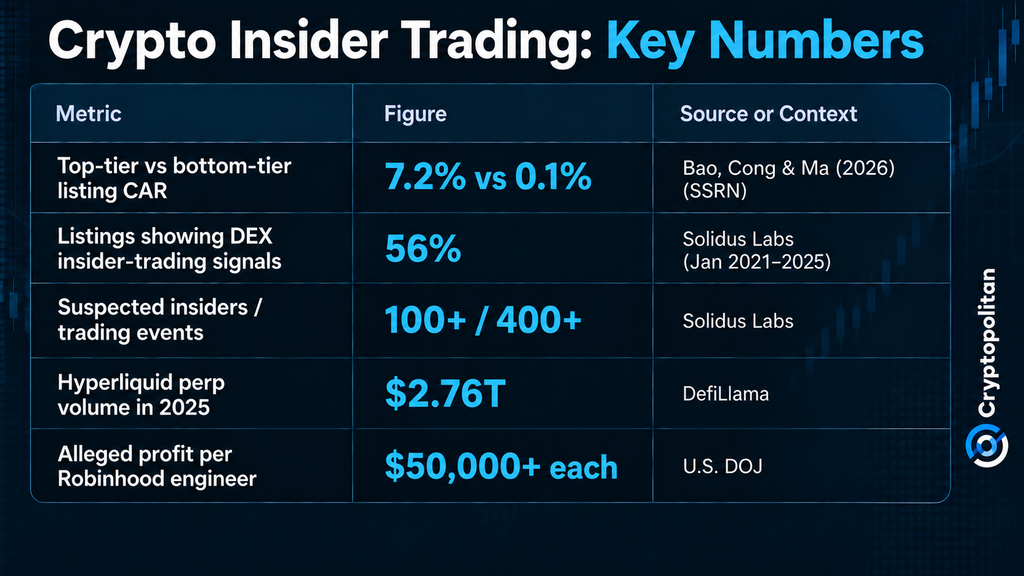 Crypto Insider Trading Statistics: Token Listing Returns, DEX Activity and Hyperliquid Volume
Pressure builds on exchanges to police their own
Robinhood is not accused of wrongdoing. Its December 2025 insider-trading policy applies restrictions to crypto trading both on Robinhood and elsewhere, treats planned listings as potentially material information, and bars trading related financial instruments using material nonpublic information. The challenge is enforcing those rules when trading moves beyond the employer’s own platform.
Regulators are addressing the same gap. The UK Financial Conduct Authority has finalized its crypto market-abuse regime, while an IOSCO review of 20 jurisdictions called for stronger enforcement and cross-border cooperation.
The more immediate global market effect is likely to be higher compliance costs rather than a broad crypto selloff. Exchanges have stronger incentives to restrict employee access to listing data, monitor related derivatives and improve information sharing across platforms. Kaiko’s Q1 2026 ranking already shows how security is becoming part of competition between venues, with Crypto.com, Kraken and OKX each receiving perfect security scores.
The smartest crypto minds already read our newsletter. Want in? Join them.















 English (US)